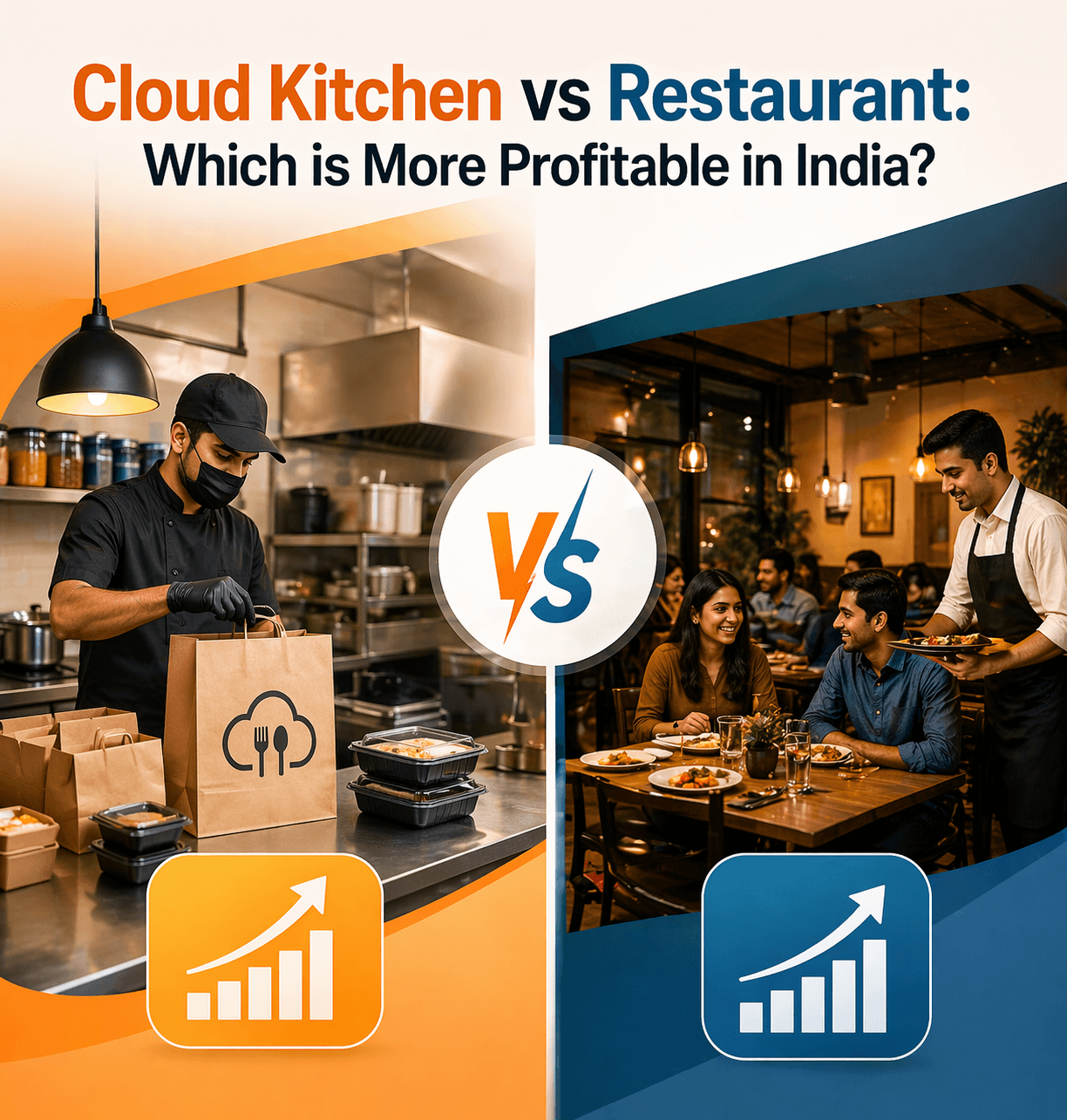
The food business in India is rapidly evolving, and entrepreneurs today face a key decision: Should you start a traditional restaurant or a cloud kitchen? While both models have their advantages, the real question is, which one is more profitable?
In 2026, the answer is increasingly clear. With the rise of Swiggy and Zomato, cloud kitchens (ghost kitchens) have emerged as a more cost-efficient and scalable option compared to traditional dine-in restaurants. Let’s break it down with real numbers and practical insights.
💸 Investment Comparison
The biggest difference between the two models is the initial investment.
Cloud Kitchen: ₹10–12 Lakhs
Restaurant: ₹20–50 Lakhs
Cloud kitchens require smaller spaces (300–500 sq ft) and eliminate expenses like interiors, furniture, and prime-location rents. This makes them a low-risk entry into the food business.
📊 Operational Cost & Profitability
🍽️ Cloud Kitchen:
Lower rent and staff costs
Focus on delivery-only operations
Net profit margins: ~10% to 15%
Monthly profit: ₹50K–₹80K
🏬 Restaurant:
Higher fixed costs (rent, staff, maintenance)
Dependency on footfall
Net profit margins: ~10% to 20% (but higher risk)
👉 While restaurants can have slightly higher margins, cloud kitchens are more efficient and predictable due to lower overheads.
⏱️ Break-Even & ROI
Cloud Kitchen:
Break-even: 3–6 months
ROI: ~12–13 months
Restaurant:
Break-even: 12–18 months
ROI: 18–24 months
👉 Faster recovery makes cloud kitchens a more attractive investment.
📦 Scalability
Cloud Kitchen:
Easy to expand into multiple locations
Can run multiple brands from one kitchen
Higher order volume potential
Restaurant:
Expansion requires heavy capital
Limited to one cuisine/location
Slower growth
👉 Cloud kitchens win in scalability and growth speed.
📍 Risk Factor
Cloud Kitchen: Lower risk due to smaller investment and flexible operations
Restaurant: Higher risk due to fixed costs and dependency on footfall
👉 In uncertain markets, cloud kitchens are safer and more adaptable.
For beginners and investors looking for a smart, low-risk entry into the food business, cloud kitchens offer a clear advantage. With delivery demand rising and operational costs lower, they provide a better risk-to-reward ratio compared to traditional restaurants.